Saturday, February 29, 2020

West out on the edge

This week I went West - out to the edge of Tasmania, just for a brief visit. It is an elemental place - raw and dramatic and beautiful.

There were waterfalls everywhere, tumbling over rocks to the road as I drove up the 99 bends and tiny minature waterfalls beside the board-walked track that clings precariously to the side of Mt Owen, the bare pink conglomerate massif that towers over the town of Queenstown in the valley below. Surrounded by the sound of water.

But this is why I stopped and walked into the wind and rain - Horsetail Falls in all its roaring majesty, over 50 metres in full flow - very impressive, and an easy 500 metres along the boardwalk from the carpark. 


Delicate ever-morphing patterns and the incredible power of water flowing over the angled ancient rocks. How can you not be impressed and mesmerized?

Back at the carpark, I ate my lunch cloistered in Sally, my campervan - the one with the purple and blue 'racing' stripes, the wind vibrating and shaking. White quartz runs through pink Mt Owen conglomerate.

In Hobart, the museum currently has a fascinating exhibition. 'On the edge of the world lies a distinctive, complex and compelling place...'

Four rooms covering the geologic, natural, human, industrial and inspirational elements of this western edge. First People's creation stories, geology, industry and mining, and much more.

'Inspired by the West' - My parents' had a orange tent like this one, owned by famous wilderness photographer, Olegas Truchanas.

Early wilderness photography.

And current artists. Did you know that a few years ago there were three art galleries in Queenstown? Now, there are ten! And two bookshops! And a couple  of new cafes.

The West truly is a sublime and inspiring place.

A section of Raymond Arnold's 'Elsewhere World' juxtaposed with my photos of a King Billy pine stump,  and Horsetail Falls. Nature reasserts itself after our environmental vandalism.

Do yourself a favour - go and see West Out on the Edge, on at TMAG until May 10, 2020. And then - embrace the water and the wildness, and go west!

Sunday, February 16, 2020

Seeing the small things


When we think of a landscape scene we generally think in terms of sweeping vistas, towering cliffs, huge expanses of sky - the big picture.
We forget these large views are made of small, tiny things - grains in rock, pebbles, tiny plants and fungi, insects and small animals - things we may not even see, but which are vital. If insects such as bees, beetles and butterflies were not present in the landscape, it would die, change irrevocably. No pollinating insects means plants do not reproduce. If there are no plants other larger animals, including humans, die.

Little things matter. Here are just a few of the little things we saw along the Path - the South West Coast Path.

Grains in granite boulders
Quartz veins
Shale and slate
So many different geologies
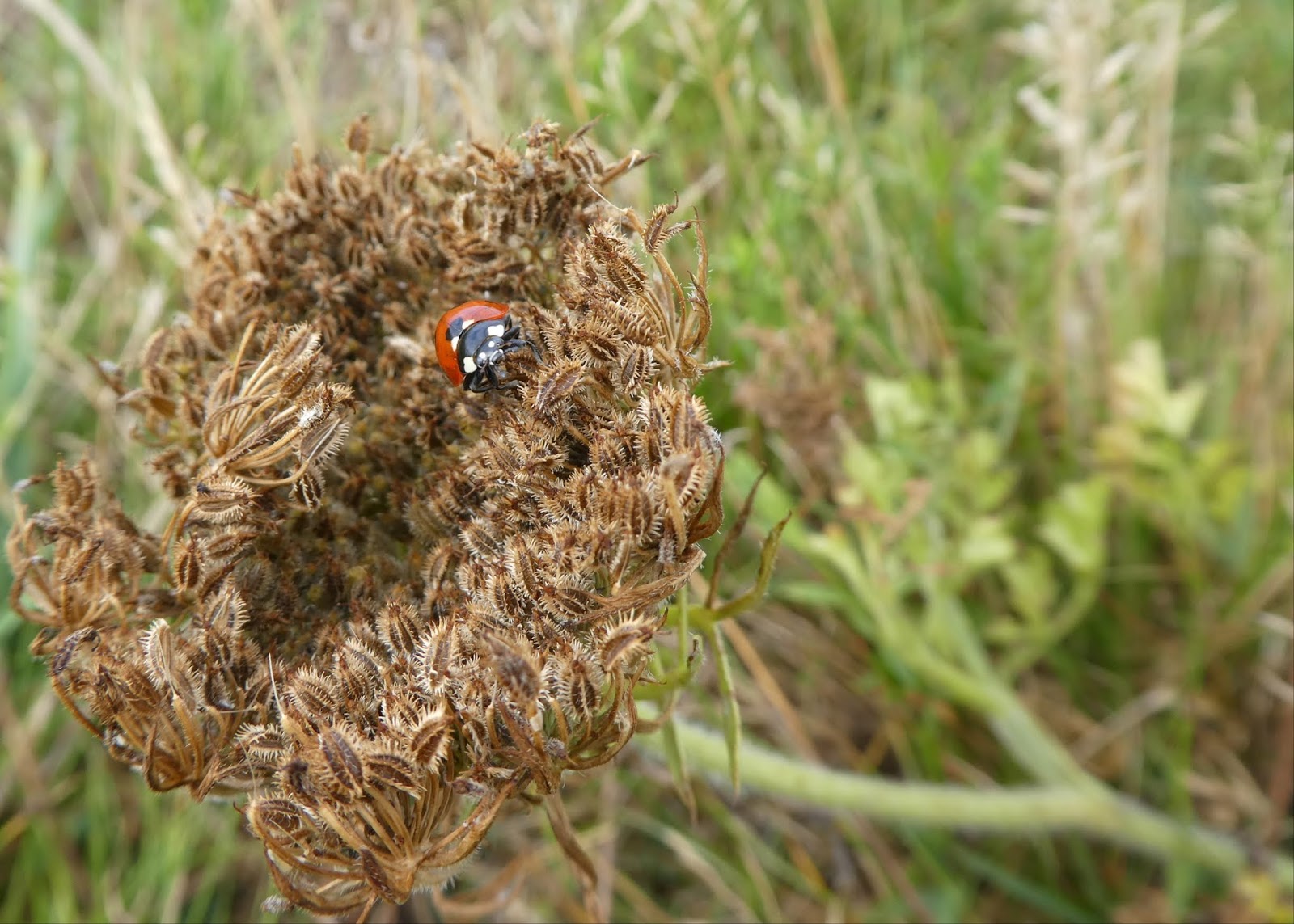
Lady beetle on seed head
Caterpillar eating buttercup
Butterflies on a butterfly bush, aka buddleia
Butterflies pollinate
They are very sensitive to changes in the environment
Bees pollinate, without them we die.
The UK only has three varieties of lizards. Australia has dozens.
Shrew, tiny and related to moles and hedgehogs
Harvest mouse who almost got walked on.
Beautiful and useful, dung beetles eat and break down animal pooh.
Building a web at human knee level on a walking path is might not be a good survival skill.
Jewel-like berries on a vine. Bird food.
Another bee busy saving the world
Devil's Coach Horse beetle eats other tiny creatures
Blackberries - yummy - feed hungry walkers and birds
A complete aquatic ecosystem in a disused water trough
Death is a vital part of life
Appreciate Nature - Without Nature - Nothing


Wednesday, October 30, 2019

The End

The last walk. It was cold and dreary at Swanage.
Old Harry's Rocks were interesting. Depending on which legend you choose to believe, Harry is either a pirate, a viking or the devil.
After a nice lunch at a National Trust cafe on Knoll Beach, we walked along it, past the Naturists area. Funningly enough, everyone we saw was very well clothed against the cold.
At the end marker of the South West Coast Path on the ferry wharf to Sandbanks and Poole. The ferry was not running but we didn't need it as we had our little hire car. We walked into a pretty birch grove near the car park and planted the two acorns we had carried all the way from the beginning in Minehead.
We may not have walked the entire 1014 kms of the South West Coast Path, but that is OK. We have finished OUR Path. Everyone's path is different. 
We walked all of the north Somerset and north Devon coastline, all of the Cornish coast and selected sections of the south Devon and Dorset coastlines. We walked 733.2 kms of the official South West Coast Path over 70 days with 16 non-walking, sight-seeing, clothes-washing days included. We have experienced, learned and enjoyed our Path. 
Thankyou for reading and following our Path. Now, go out and find your own.

Monday, October 28, 2019

Beautiful crumbling Earth

Are we crazy? Some of the cliff-falling-down signs along the Jurassic Coast are a bit scary! And we are walking along sections of these cliffs.
Lyme Regis, where Mary Anning made some of the most important fossil finds in the 19th century and people still find fossils today.
We walked along the huge concrete sea wall that was completed in 2014 in an attempt to prevent the town from falling into the sea.

Our path then diverted inland around a large landslip area returning to the coast at Charmouth before another inland diversion. Lots of people were searching for fossils on the beach below the cliffs we had just walked around.
Heading up Golden Cap, at 191 metres, it is the highest point of the southern English coast.
Great views. And a pub on the beach at the bottom for chunky chips and cider as the late afternoon sun glowed golden on the cliffs.
Chesil Beach is a 29 km long, 15 metre high ridge of shingle, aka rounded stones, with a saline lake behind it. We decided not to walk the entire distance on the path that stays inland of the lake. We did climb the hill to St Catherine's chapel near one end.
The view from the chapel toward the Isle of Portland on the horizon. It is not quite an island as Chesil Beach connects it to the mainland. This photo does not do justice to the view and it was not possible to fit the entire beach in one photo.
Zooming in on the Isle of Portland end of Chesil Beach gives a bit of an idea of the way it seperates and joins land and water except you can't see the large open harbour that sits behind the hill on the left. Sometimes you just have to be there yourself.
We drove to the Portland end and walked on Chesil Beach. It is steep, wide and very hard to walk on. The beach was fascinating. These photos do not show its three-dimensional shape or the unique way the waves were breaking or the musical sound of the stones being thrown and rolled by the water.


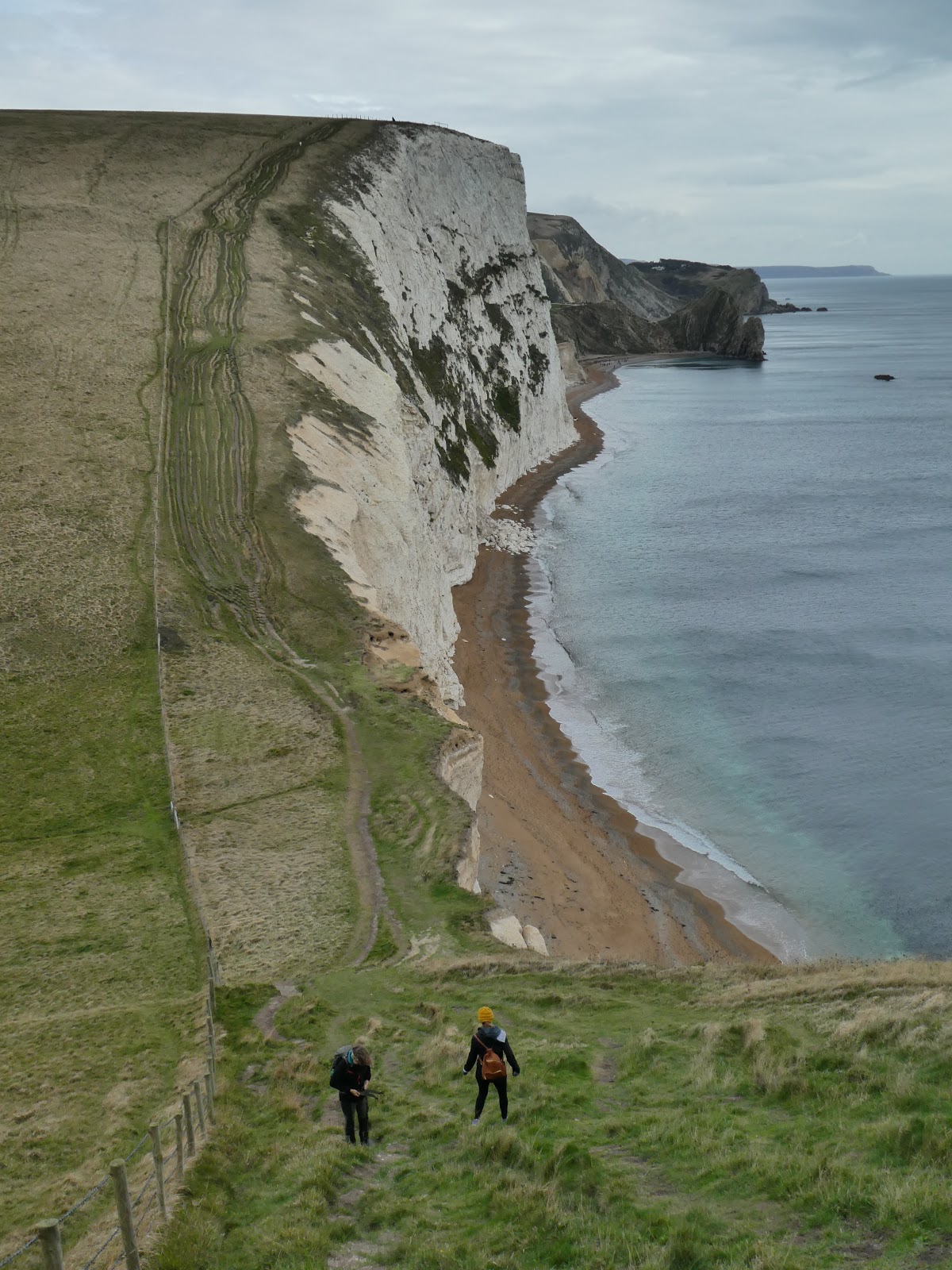
On the other side of the Isle of Portland and Weymouth is a stretch of white chalk cliffs. The squiggly lines near the cliff edges are the path we walked.
 Q20507725


There were some very steep ascents and descents. The valley at the bottom pf this onecwas called Scratchy Bottom!

Durdle Door, one of the best known features along this section of coast visited by thousands and thousands of people each year.
We spent some time down on the beach. This is a quiet time of the year.
Kids climbing out of caves eroded by the sea in the base of the cliffs, part of the cliff-falling process.
Nearby is Scarehole Bottom, kayakers paddling through its multiple arches
Lulworth Cove is an almost perfect circle shape with a gap opening to the sea. Both Lulworth Cove and Durdle Door belong to the privately owned Lulworth Castle Estate which makes a lot of money from people paying to park and to stay. I suspect that yacht moored here belongs to the owner of the estate.
Fossil forest on a large ledge on the cliff below the path. The round shapes indicate where trees once grew.
Looking but not walking at the next quite long section of coast that lies within Ministry of Defence land and is not always open to the public. We chise not to walk here.
These pictures are just a few from four days of walking the Jurassic Coast.