Tuesday, August 20, 2019

A rest day


Now, it really begins. The acorn is the symbol of Britain's National Trails and is on all the sign posts for the South West Coast Path. This scuplture is on the promenade at Minehead is the official beginning of the path.
After an all day train journey from Edinburgh to Taunton in the west of England where we stayed one night, then a 1 hr 30 min bus trip to Minehead for two nights. There is one of those awful Butlins holiday camps at the other end of the beach but the town itself is quite nice.
Sheryl's relative? A shop in the main street.
A day exploring the medieval village and castle of Dunster. The castle dates back to 1066 with more recent additions, the hexagonal yarn market building is from 1609.
This village just kept on giving. So much history and so much quaintness! The postie crossing the ancient and rare pack horse bridge.
An old trade - roof thatchers at work.
Possibly one of the most beautiful old churches I have been in - St Georges
Not just old, spiritually active, full of flowers and beautifully carved wooden rood screen, lots of little spaces on the sides and an atmosphere of real peace
 And the Light!
In the garden near the castle's working water mill.
 The castle stables
The castle
I took lots of photos of extragant rooms. The Lady of the castle from the 1920s was a an Australian who married into the family. She held lavish parties.


Back in the early days the castle had a dundeon where people were dropped into via a trap door and left to die. Skeletons have been found including a seven foot one still chained to the wall.
This is the inside of a large dovecote, holes in the walls for doves to live in.
 The dovecote is the cyclinderical building at the end of this garden.
The Dream Garden. Yes, that is what it was called.

More cuteness.

We had walked about 4km through the countryside from Minehead to Dunster, ate blackberries from hedge rows and apples from the community orchard, wandered the village and castle all day, and caught a bus back to Minehead late in the afternoon. And this was supposed to be a rest day before starting the big walk!
Donkeys by the bus stop. I have never seen a patchy coloured donkey before. His friends came over for an ear rub.

Saturday, August 17, 2019

One of the biggest

One of the largest book festivals in the world - Edinburgh Book Festival. We treated ourselves to 2 days.
Alexander McCall-Smith was very entertaining, plenty of laughter. "The landscapes of our childhood are important" 
Neil Oliver - archaeology, history, places that tell stories and being able to touch things and stand in the same place as another person did thousands of years ago. The past is important as it tells us who we are today.
The whole festival is held in marquees with wooden walkways set up in one of Edinburgh's grassy city squares.  There were two large bookshops set up in marquees...so many tempting books! S bought one but I was too overwhelmed by the choices and bought nothing. Some of the queues were very long! This is the beginning of our queue for Alexander MaCall-Smith.
Two Marks - finding joy in the simple rythmn of walking all day every day in "How to kill a mole". Yes, he did once earn a living killing moles. And living without modern tecnology - I like the idea but I don't think I could go as far as he did in "The Way home"


Brigid Benson's book about travelling the northern highlands of Scotland. Travel slowly, get off the tourist trail, spend time really connecting with the places you visit. And she takes beautiful photos.
Oh my! SO SO MANY BEAUTIFUL BOOKS!


Friday, August 16, 2019

Love the Borders

A few highlights of our past 10 days in the Borders of Scotland.

Walking a section of the old pilgrimage route, St Cuthberts Way near St Boswells which has a wonderful bookshop-cafe.
Lunch in the Chapter Room at Dryburgh Abbey, with the heavenly peaceful (recorded) singing of monks playing from somewhere unseen.
A very affectionate horse lowering his head in bliss when I rubbed between his ears.
Traquair House, the oldest continally inhabited house in Scotland, over 900 years old, visited by 27 Scottish kings and queens. 
History made real. Mary Queen of Scots actually slept in this bed and her son James slept in the wooden cradle half a century ago. 
Narrow winding stairs. These ones in Traquair House were wide compared to the one in the abbey buildings at Melrose and Dryburgh.
Walking in the rain. Leaderfoot viaduct once carried trains over the Tweed River. Near Melrose where my 4xgreatgrandfather was a blacksmith in the 19th century.
The Eildon Hills before it started to rain.
Robins. We keep seeing them everywhere.


Sunday, August 11, 2019

Summer in Scotland


Summer in Scotland.
Scotland greeted us with sunshine streaming in through the airport windows that became rain streaming, thundering, drenching as if we were in the tropics by the time we walked outside to wait for a bus. Welcome back to Scotland! To be fair, the weather hasn't been all bad. But the photo above was today on the Royal Mile in Edinburgh. We had just been evacuated from the museum as the fire alarms went off. There were hundreds of umbrellas leaving the museum.

Our first 10 days are in Galasheils, a 50 minute train ride south of Edinburgh, in The Borders.
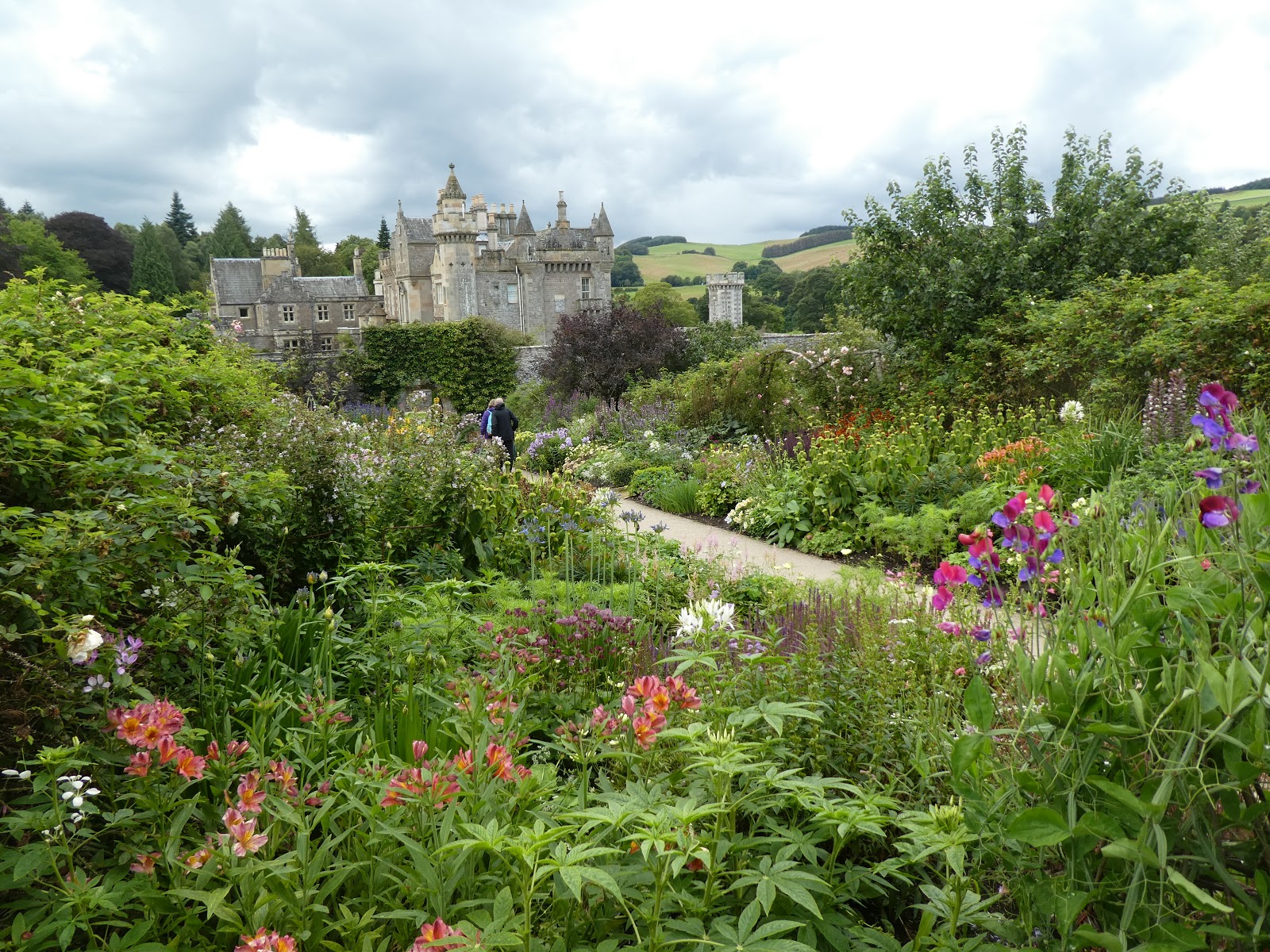
On our first day, still feeling jetlagged, we strolled around Galasheils and then walked about 8kms return along Gala Water (the stream that once powered mills in Galasheils) and along the Tweed River to Abbotsford. This is what we came for.
Abbotsford was once a simple farmhouse. But in the 1700s, lawyer and famous writer, Sir Walter Scott purchased it and began "renovating." I love that he followed his creative inclinations rather than the fashion of the day. But the result is rather over the top, certainly unique.

Abbotsford stayed in the family after Scott died in 1832 in a bed set up for him in the dining room following a series of strokes which left him unable to walk up the stairs to his bedroom.
The interiors of the downstairs have been kept pretty much as when Scott was alive. Including his 9,500 volume library, leather bound with his monogram and his smaller study off the library, which is also lined with books.
Scott's portrait hangs in the drawing room decorated by his French wife, Charlotte.
If you don't know who Scott is...google him. He is sometimes called 'the man who invented Scotland.' There are monuments all over the country to him. The main train station in Edinburgh is named after one of his novels. But more than that, he gave us phrases we use all the time including: apple of my eye, blood is thicker than water, what a tangled web we weave, and back of beyond.
I am ashamed to say I have never read any of Scott's many books. I really should rectify that. My impression of him is that he was a very nice person too, even though he was a huge celebrity in his day. US presidents and royalty were among those listed in the visitors book.
And he liked dogs.

Abbotsford's name comes from the ford across the river nearby which was used by the monks and abbots from the nearby Melrose Abbey. The 12th to 15th century abbey housed 50 Cisterian monks and 150 lay monks who did most of the manual labour including running the largest sheep farm in Europe!
Scott personally supervised work to save the abbey ruins and had his architect take plaster casts of many of the gargoyles to make copies which are installed in his armory and entrance hall.

Not even the call of nature interrupted spiritual service.
For some unexplained reason there is a bagpipe playing pig gargoyle up on the roof.
Melrose also has an interesting suspension bridge over the Tweed River and views of the Eildon Hills. 
And the first scones of the trip, complete with gum leaves on the table.